
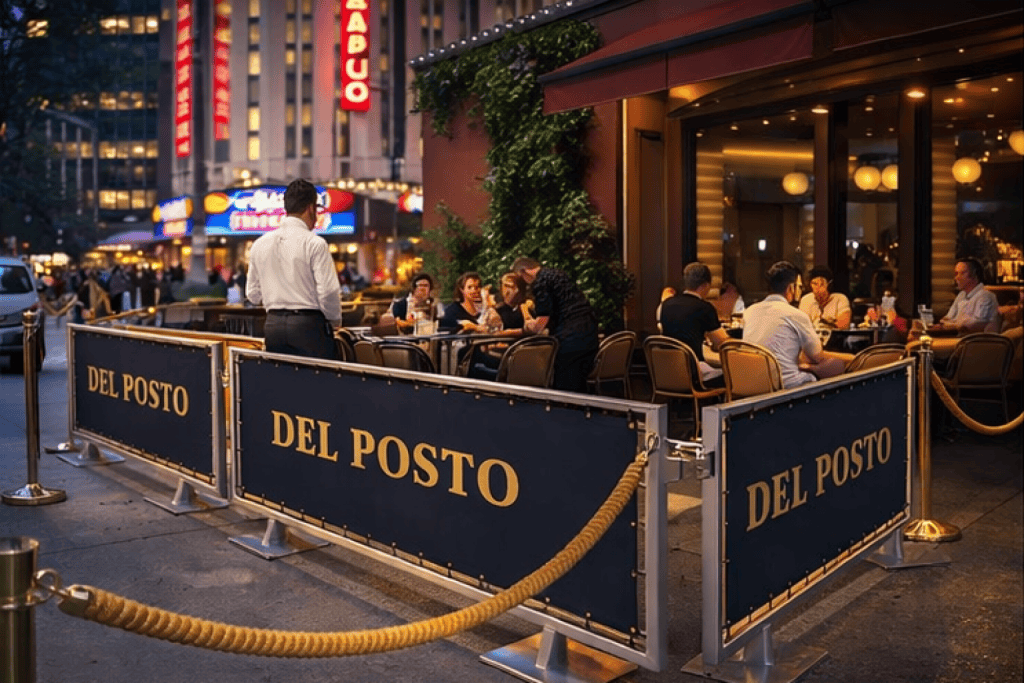
Restaurant Patio Barriers: Which Materials Make Sense Now?
Restaurant patio barriers work best when the material matches both daily restaurant use and the permit path in your city. We have been a 75+ year family-owned business for a long time, and we have seen attractive barrier ideas fail because the material choice ignored visibility, removability, or access rules.
TL;DR: Summary
- For most restaurant patio barriers, commercial-grade aluminum or steel rail systems are the safest all-around choice because they balance durability, visibility, removability, and permit-readiness.
- Glass, acrylic, and polycarbonate work best as infill panels when open sightlines matter; glass looks clean but is heavier, acrylic is lighter but scratches more easily, and polycarbonate handles impact better.
- Some cities restrict barrier type or size. Boston allows only concrete jersey barriers or water-filled barriers for on-street patios and caps barrier height at 36 inches, while Costa Mesa allows barriers up to 5 feet with transparency rules in the upper section.
- Code-safe barrier design usually means clear pedestrian paths, no blocked egress or fire equipment, visible edges, and removable sections that do not penetrate the public way.
- If you are budgeting a custom system, use $135 per linear foot as a practical starting point, then adjust for infill material, gates, branding, engineering, shipping, and installation.
If you run a restaurant in NYC, Manhattan, Brooklyn, Queens, Long Island, NJ, Philadelphia, MD, or DC, the right barrier material is not just a style choice. It affects approvals, maintenance, guest experience, and how well the system holds up once weather, carts, and daily service start hitting it.
Which restaurant patio barrier materials are safest for permits and daily use?
Commercial-grade aluminum rail systems and steel pipe and rail are usually the safest baseline in NYC and Philadelphia. They stay rigid, stay visible, and can be fabricated as removable sections that fit the common permit pattern of clear paths, emergency access, and no damage to the public way.
That matters because many outdoor dining rules do not look only at looks. Boston’s 2025 outdoor dining guidance requires on-street patio barriers to be concrete jersey barriers or commercially available water-filled barriers, requires reflective elements, and limits height to 36 inches. Costa Mesa allows taller enclosures, up to 5 feet, but still requires the upper 1.5 feet to stay open or transparent outside the traffic visibility triangle.
“Quality Sidewalk Barricades has been family-owned for 75+ years and fabricates each system in-house in America.”
Across our work in NYC, Long Island, NJ, Philadelphia, MD, and DC, the safest material choice is usually the one that stays obvious to pedestrians, does not create blind corners, and can be removed or reconfigured if the agency asks for changes. A common mistake is assuming a heavier barrier is always better. If it blocks sightlines or interferes with egress, weight does not help you.
How do aluminum and steel compare for restaurant patio barriers?
Aluminum and steel both work, but they solve different problems. Aluminum is lighter and corrosion-resistant, while steel pipe and rail brings more mass and can feel sturdier at curbside.
Commercial-grade aluminum with a powder coat finish is often the easier choice for sidewalk cafés and modular setups. Crews can move sections more easily, and corrosion is usually less of a concern in wet, salted, or coastal conditions. If you expect seasonal removal or frequent layout changes, aluminum usually makes life simpler.
Steel pipe and rail makes sense when you want a more traditional streetscape look or need extra rigidity in narrow runs. The trade-off is upkeep. Steel needs proper finishing and ongoing attention where chips or wear show up. Since we fabricate in-house in America, we can control fit, weld quality, and finish details instead of relying on imported stock that may not match field conditions.
Many owners assume steel is always stronger in the way that matters most. It is not that simple. Joint design, base details, gate locations, and the way sections connect often matter just as much as the raw metal.
What are the 10 best materials for restaurant patio barriers today?
The strongest material list starts with systems that can satisfy visibility, durability, and removability at the same time. No single material wins everywhere, but these ten are the most practical options we deal with most often.
- Custom aluminum rail systems from Quality Sidewalk Barricades: commercial-grade aluminum with powder coat finish, well suited to removable sidewalk café layouts and Dining Out NYC review.
- Steel pipe and rail: heavier, traditional-looking, and useful where extra mass or a classic streetscape feel is preferred.
- Tempered glass with aluminum framing: open sightlines and a cleaner visual edge for higher-design dining areas.
- Acrylic panel with aluminum framing: lighter clear infill for sites that want visibility without full glass weight.
- Polycarbonate infill panels: clear or tinted impact-resistant panels for busier curbside conditions.
- Metal mesh infill: breathable, visible, and practical where full transparency is not required.
- Perforated metal panels: partial screening with airflow and a more architectural finish.
- Planter-integrated aluminum frames: a barrier plus greenery where the jurisdiction allows planter use.
- Water-filled barriers: practical only where an agency explicitly requires or allows them, as Boston does for some on-street patio conditions.
- Concrete jersey barriers with finish treatments: an agency-driven traffic protection choice, not usually a hospitality-first design choice.
The weak options are usually the ones that read as temporary or improvised. Costa Mesa explicitly disallows temporary plastics, temporary fencing, non-permanent planter areas, and temporary barriers as improvements. That is a useful warning even outside California.
How do glass panels compare with acrylic or polycarbonate infill?
Glass looks the cleanest, acrylic is lighter, and polycarbonate takes impact better. The right pick depends on sightlines, handling, and how rough the curbside environment is.
Tempered glass with aluminum framing is the premium look many restaurants want, especially in Manhattan and parts of Brooklyn where visual openness matters. It helps when a reviewing agency cares about transparency and traffic visibility. The trade-off is weight, handling, and replacement cost if a panel breaks.
Acrylic and polycarbonate are different, even though owners often group them together. Acrylic is clear and lighter than glass, but it scratches faster. Polycarbonate is tougher on impact, which helps near loading zones or tighter sidewalks, but it can show wear in other ways over time.
“Quality Sidewalk Barricades prices custom systems at $135 per linear foot, which gives restaurants a concrete starting point before graphics, gates, or installation.”
A common misconception is that clear panels are always the safest permit choice. Not always. If the city wants open sightlines in an upper zone, a mixed system with rail below and transparent infill where needed can age better than an all-clear panel layout.
How do you choose the right restaurant patio barrier for NYC, Philadelphia, MD, or DC?
Start with the permit path, then choose the material. NYC DOT, Dining Out NYC, NYC DOB, Philly Streets Department, Philly L&I, DC DDOT, DC DCRA, and MD jurisdictions all look closely at pedestrian clearance, access, and visibility.
Step 1: Identify whether the barrier sits on private frontage, sidewalk, or in-street dining area. That affects what can touch the ground, how removable it must be, and whether traffic protection enters the picture.
Step 2: Map the hard constraints before you talk style. Measure clear pedestrian path, curb line, hydrants, exits, cellar doors, and sightlines at corners or driveways. Rhode Island DOT’s guidance that barriers may not penetrate the surface of the public way is a good reminder of how often attachment details matter.
Step 3: Match the site to a material family. If you need light, modular sections, aluminum rail is usually the first look. If you need more screening, perforated panel or mesh may work. If you need transparency, consider glass or polycarbonate infill. We have navigated approvals for NYC DOT, Dining Out NYC, Philly Streets Department, Philly L&I, MD jurisdictions, and DC DDOT and DC DCRA, but no one should promise approval before a site is reviewed.
How do you budget restaurant patio barriers without getting surprised later?
For most custom restaurant patio barriers, start with $135 per linear foot. Then adjust for material type, infill, gates, branding, engineering, shipping, and installation.
That base number helps early planning, but it is not the full project math. A straight aluminum rail run prices differently than a glass-panel system with logo panels, custom gates, and engineered details for a curbside condition in Manhattan or DC.
A simple way to structure the budget is this:
- Base run: linear footage at $135 per linear foot
- Material choice: aluminum rail, steel pipe and rail, glass, acrylic/polycarbonate, mesh, or perforated panel
- Project add-ons: gates, branded panels, planter integration, engineering, crating, shipping, and installation
A common mistake is treating price per foot as the final number. If you need site survey, permit-ready drawings, or rush turnaround, the labor picture changes. Because we fabricate in-house in America, material control is tighter and scope stays clearer than when parts are sourced from multiple outside vendors.
How do you move from site measurements to fabrication and installation?
The cleanest projects follow a fixed sequence: survey, design, engineering, permitting guidance, fabrication, and installation. That order saves rework.
First, measure the real site, not just the lease line on paper. Sidewalk pitch, curb condition, utility covers, and entrance swings can change panel widths and gate placement. In older parts of Manhattan, Brooklyn, and Philadelphia, that matters more than many owners expect.
Next, turn measurements into a specific system. That includes material, panel type, height, removable or modular connection details, and graphics if needed. If branding matters, we can adapt standard looks like Greenwich Village, Madison Square, SoHo, Bay Ridge, Broadway, or Times Square styles to the actual footprint instead of forcing a stock size.
“Quality Sidewalk Barricades provides site survey, design, permitting guidance, fabrication, and installation, and we crate and ship complete systems nationwide and internationally.”
Then fabricate and install to the approved layout. If you are outside our regional install area, we crate and ship complete systems nationwide and internationally. Pro tip: ask about replacement parts early. Panels, hardware, and touch-up plans matter after the first busy season.
Do restaurant patio barriers need to be removable and visible?
Yes, in many jurisdictions removable and visible is the safest assumption. Fairfax County requires outdoor dining elements to be temporary and removable, and Boston requires reflective elements on barrier exteriors.
That pattern shows up again and again. Agencies want pedestrian passage protected, building entrances and exits clear, and emergency egress untouched. Rhode Island DOT bars barriers from penetrating the public way surface. Fairfax County bars obstruction of fire equipment, building exits, ADA accessibility, and pedestrian passage.
Visibility also matters above the rail line. Costa Mesa’s rule allowing a solid lower 3.5 feet but requiring the upper 1.5 feet to remain open or transparent outside the traffic visibility triangle explains why many successful barriers mix materials instead of using one fully solid wall.
What height and transparency rules matter most for restaurant patio barriers?
The key rule is that height and transparency often work together. Boston caps on-street barriers at 36 inches, while Costa Mesa allows up to 5 feet but requires transparency in the upper zone.
Even if your city does not use those exact numbers, the logic is familiar. Reviewers want a barrier that defines the dining area without creating a blind wall. If your corner, driveway, or curb cut has sightline issues, transparent or open upper sections are usually easier to defend than a fully solid screen.
If you want privacy, use it carefully. Perforated metal or mesh can soften views without turning the patio edge into a visibility problem.
Can planters, mesh, or decorative panels count as restaurant patio barriers?
Yes, sometimes, but only if the jurisdiction allows them and the assembly still functions as a real barrier. Planters can help, yet they do not automatically replace a permit-ready barrier system.
Costa Mesa allows planter boxes to satisfy landscaping requirements, but it does not allow temporary planter areas or temporary barriers as improvements. That is an important distinction. A planter-integrated barrier works best when the planter is part of a fixed, fabricated frame rather than a loose row of pots.
Mesh and perforated metal usually work better than improvised fabric screens or temporary fencing. They stay visible, hold shape, and can be framed in aluminum or steel. If you need branding, printed panels or logo plates usually age better than applied temporary wraps.
Where should you start if approval timing is tight?
Start with exact measurements, a simple material package, and a realistic permit review path. Aluminum rail with selected infill is often the fastest place to start because it is modular, visible, and easier to adapt.
If your deadline is short, keep the first submission clean. Show dimensions, gate swings, pedestrian path, and the barrier material clearly. Avoid overcomplicating the first round with decorative elements that do not help approval. Then add branded details once the core layout is settled.
If you need help sorting through restaurant patio barriers for NYC, Long Island, NJ, Philadelphia, MD, or DC, or you need a shipped system elsewhere, call +1 (800) 561-6522 or visit the contact/shop page.