
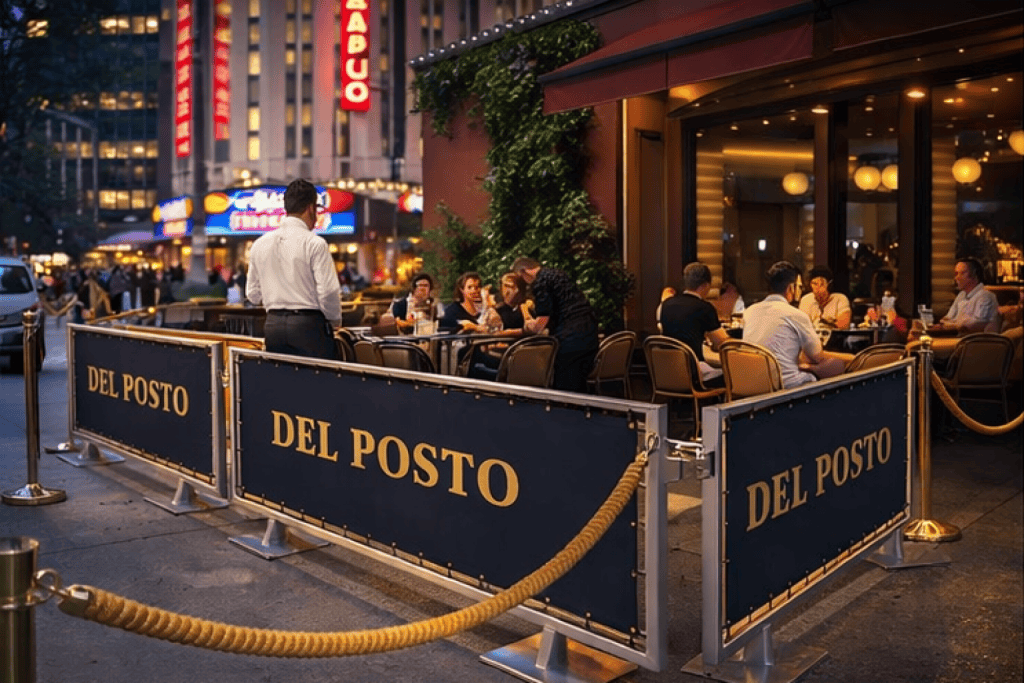
Which patio divider panels work in tight sidewalk spaces?
Tight sidewalk patios are won or lost on inches. In Manhattan, Brooklyn, Philadelphia, and DC, the wrong divider panel can wipe out the clear path, trigger permit revisions, or leave you with a layout that never really worked.
TL;DR: Summary
- Patio divider panels that fit tight sidewalk spaces are usually low-profile, custom-measured systems, most often aluminum rail, steel pipe and rail, glass with aluminum framing, acrylic or polycarbonate infill, mesh or perforated metal, or modular planter-integrated panels.
- The first design test is pedestrian clearance, not appearance. ADA accessible routes generally need 36 inches clear, with a limited 32-inch pinch point allowed for up to 24 inches, while NYC sidewalk cafés must keep at least 8 feet or 50 percent of the sidewalk width clear, whichever is greater.
- In NYC, a regular unenclosed sidewalk café cannot use a railing, planter, base wall, or fence higher than 30 inches. Other jurisdictions may allow up to 36 inches, but permit conditions control the final height.
- If your layout includes turns, obstructions, or a public path between the café and curbside setup, the panel type, gate swing, and footing method should be drawn around those conditions before fabrication.
- For tight sites, modular or removable patio divider panels usually work better than bulky fixed enclosures because they preserve sightlines, simplify operations, and can fit permit requirements more cleanly.
- At Quality Sidewalk Barricades, we have been family-owned for 75+ years, we fabricate in-house in America, and we price standard sidewalk café barricades at $135 per linear foot so you can budget early.
At Quality Sidewalk Barricades, we have been family-owned for 75+ years, and we have fabricated sidewalk café systems for exact site conditions across NYC, Long Island, NJ, Philadelphia, MD, and DC. When you are dealing with a narrow public sidewalk, the right answer is usually a custom low-height system built around clear-path rules first, then materials, then permit drawings.
Why do patio divider panels fail in tight sidewalk spaces?
Yes. In NYC and under ADA route rules, patio divider panels fail when layout starts with furniture instead of the clear path. On a public sidewalk, the walking route comes first and the divider style comes second.
A common mistake is measuring only the seating zone and not the full sidewalk condition. Tree pits, cellar doors, hydrants, subway stairs, sign posts, bike racks, and curb ramps all affect the usable line where panels can sit. In NYC, a sidewalk café must leave at least 8 feet or 50 percent of the sidewalk width clear, whichever is greater, along the frontage.
That means a panel that looks slim on paper can still make the site nonworkable. If a large obstruction sits along the frontage, NYC requires at least 15 feet between the café and that obstruction. On a truly narrow sidewalk in SoHo or the Upper West Side, that can rule out the café footprint before the panel material is even discussed.
How much clear sidewalk width do patio divider panels need?
The hard floor is 36 inches under ADA route rules, but many sidewalk café sites need more. NYC and turning conditions often push the real working width above the bare minimum.
The U.S. Access Board states that accessible routes generally require 36 inches of clear width. A narrow 32-inch segment is allowed only for up to 24 inches, and only if wider segments separate it. If the route makes a 180-degree turn around an element less than 48 inches wide, the path must be 42 inches wide approaching the turn, 48 inches at the turn, and 42 inches leaving it.
“Quality Sidewalk Barricades has been family-owned for 75+ years and builds custom sidewalk café barricades around exact site measurements.”
If the accessible route is narrower than 60 inches, passing spaces are required at intervals of 200 feet maximum. That rule matters less on short café frontages than the everyday reality: people stop, queue, carry bags, and push strollers. We tell owners in Manhattan and Brooklyn to treat the legal minimum as the floor, not the goal.
What patio divider panels fit tight sidewalk spaces best?
The best patio divider panels for narrow sidewalks are low, custom-measured, and easy to place around obstructions. In NYC and Philadelphia, slimmer panel footprints usually beat bulky bases and deep planters.
After the site is measured, these six types are the ones we see work most often in constrained right-of-way conditions:
- Quality Sidewalk Barricades modular aluminum rail panels: commercial-grade aluminum with powder coat finish; typically 30 inches in NYC and up to 36 inches where allowed; best when you need custom corners, gates, and exact clear-path control.
- Steel pipe and rail panels: welded steel with painted or powder-coated finish; usually 30 to 36 inches where permitted; useful where extra rigidity matters more than low weight.
- Glass panel systems with aluminum framing: clear or tinted glass within aluminum frames; usually kept at 30 inches in NYC sidewalk café work; good when you need sightlines for storefront visibility.
- Acrylic or polycarbonate infill panels: transparent infill in aluminum framing; often 30 to 36 inches where the permit allows; useful when you want visibility with less weight than glass.
- Metal mesh or perforated panel dividers: steel or aluminum frame with mesh or perforated infill; generally 30 to 36 inches; a practical choice where ventilation and lower visual mass matter.
- Planter-integrated removable panels: aluminum or steel rail sections tied to planter elements; often kept at 30 inches in NYC regular unenclosed cafés; useful when delineation is required but the setup still needs seasonal flexibility.
The right pick depends on the sidewalk, not the catalog. If the frontage is short and crowded, modular aluminum rail or light framed infill panels usually give you the most control with the least wasted depth.
How do you measure a narrow sidewalk café layout before picking panels?
Measure the walking path first, then the café line, then the panel runs. In Manhattan and Queens, that order prevents most redesigns.
Step 1 is to measure from building face to curb at several points, not one point. Sidewalks drift. A frontage that starts at 12 feet can shrink near a tree pit or cellar door, and that narrowest condition controls your usable panel line.
Step 2 is to map every fixed obstruction and every turning move. If pedestrians must bend around a sign post or a stair rail, the turn can need 42 inches, 48 inches, then 42 inches under ADA rules. One mistake we see often is treating those turn zones like straight runs.
Step 3 is to draw the proposed panels, gates, and furniture inside the remaining legal area. If the gate swing cuts into the clear route, you have not really preserved the route. The cleanest fix is often a shorter return panel or a modular opening, not a thinner chair.
How do aluminum rail panels compare with steel pipe and rail for sidewalk patios?
Aluminum rail panels are usually the better fit for tight sidewalks, while steel pipe and rail make sense when extra rigidity matters. Aluminum and steel both work, but they solve different problems.
Commercial-grade aluminum with powder coat finish gives you lower weight, easier handling, and less visual bulk. On removable systems, that matters. With our 100% in-house American fabrication, aluminum also lends itself well to custom brackets, odd angles, and panel lengths that match a tricky Manhattan or Hoboken frontage.
Steel pipe and rail has a more substantial feel and can take repeated abuse well. The trade-off is weight and handling. If your staff needs to reconfigure panels, or if the site has frequent access needs for deliveries, aluminum usually makes daily life easier. If the site stays fixed and takes a lot of impact, steel can be the right call.
How do glass panels compare with acrylic or polycarbonate infill in windy urban sites?
Glass looks sharper and stays clearer longer, while acrylic or polycarbonate infill is lighter and easier to move. In NYC and DC, the right choice depends on visibility, handling, and daily wear.
Glass panel systems with aluminum framing are often chosen when storefront visibility matters. They keep sightlines open, which can help on narrow sidewalks where a bulky barrier makes the café feel tighter than it is. The trade-off is weight and care during handling.
Acrylic or polycarbonate infill reduces weight and can be more forgiving in removable or modular setups. A common misconception is that clear plastic always looks cheaper. It depends on the framing, edge detailing, and how well the panel is maintained. If staff will move sections often, acrylic or polycarbonate can be the more practical choice.
How do you choose the right patio divider panel height for NYC, Philadelphia, and DC?
For public sidewalk cafés, lower is usually safer. NYC is the clearest example because regular unenclosed sidewalk cafés cannot use barriers higher than 30 inches.
Start with the jurisdiction and the permit type. In NYC, Dining Out NYC rules matter, and a regular unenclosed sidewalk café cannot use a railing, planter, base wall, or fence higher than 30 inches. That one number rules out a lot of off-the-shelf divider products that were designed for private patios, not public sidewalks.
Then match the height to the use case. San Diego caps sidewalk café enclosures at 3 feet, which is a useful benchmark for how many cities think about open sidewalk dining. In Philadelphia, you still need the Streets Department Right-of-Way Unit approval before the sidewalk café license, and in DC you should expect DDOT and DCRA review to care about the drawings, footprint, and how the barrier is shown.
“Quality Sidewalk Barricades handles site survey, design, engineering, permit help, fabrication, and installation from one source.”
One more point. Taller is not always better. On a narrow sidewalk, extra height can create an enclosure look, block sightlines, and complicate review. If you are in Manhattan or Brooklyn, start at 30 inches unless the permit path clearly supports something else.
How do modular or removable patio divider panels help with permits and daily operations?
Modular and removable panels usually make tight sidewalk sites easier to run. NYC, Philadelphia, and Oakland all point to the same operational truth: public-space installations often need flexibility.
Oakland treats sidewalk café permissions as revocable and allows temporary partitions only if they are removed at the close of each business day. Permanent or semi-permanent barriers, including bolted railings, need a separate encroachment permit there. That is not our core market, but it is a useful reminder that public right-of-way is never your private patio.
In our work across NYC, Long Island, NJ, Philadelphia, MD, and DC, removable sections often help with cleaning, winter storage, façade work, and changing curb conditions. The pro tip here is simple: do not assume bolting down is the more professional answer. In a lot of sidewalk café situations, modular removable hardware is the cleaner operational answer and the easier one to document.
“Quality Sidewalk Barricades uses 100% in-house American fabrication for custom modular and removable patio divider panels.”
How do you budget patio divider panels without quote games?
Start with linear footage. Our standard sidewalk café barricade pricing is $135 per linear foot, which gives most owners a usable first-pass budget.
That baseline gets you out of the fog fast. If your frontage and returns total 24 linear feet, you can sketch a starting number before getting into material upgrades or permit drawings. We keep it plain because owners need a real number early, especially when the site decision depends on whether a narrow sidewalk can support outdoor dining at all.
“Quality Sidewalk Barricades prices standard sidewalk café barricades at $135 per linear foot.”
A few items still change the final cost:
- Material choice: aluminum rail, steel pipe and rail, glass panel with aluminum framing, or acrylic/polycarbonate infill
- Configuration: gates, corners, returns, planter integration, modular/removable hardware
- Project scope: site survey, engineering, permit help, installation, or crated shipment
If your site is in Manhattan, Brooklyn, Queens, Long Island, NJ, Philadelphia, MD, or DC, field conditions usually matter more than fancy finishes. The narrowest point and the permit drawing drive the job.
Can patio divider panels be bolted down or do they need to be removable?
It depends on the permit path and the sidewalk condition. NYC DOT, Philly Streets Department, and DC DDOT may all care less about your preference than about how the barrier interacts with public space.
If the permit drawings show a removable system, build a removable system. If a jurisdiction treats the setup like a temporary or revocable occupation of the right-of-way, fixed anchorage can trigger a different review path. That is why we do not treat anchorage as an afterthought.
If you need a stronger setup, there are ways to design for that without assuming permanent anchoring is required. Weighted bases, linked modular runs, and planter-integrated sections can solve stability while keeping the system workable for operations. The wrong move is buying a fixed patio product first and trying to explain it to the reviewer later.
Do branded patio divider panels slow permit review?
Usually no, if the branding does not change the footprint, height, or visibility conditions. NYC DOB reviewers and Philly L&I reviewers care more about dimensions and compliance than about tasteful graphics.
Branding works best when it is integrated into a compliant panel system. Logo panels, printed inserts, and color-matched powder coat can all be shown cleanly on drawings. The issue is not the logo. The issue is whether the branded infill becomes too opaque, too tall, or too enclosure-like for the permit type.
One misconception is that branded panels have to look heavy. They do not. A SoHo-style aluminum frame with a modest logo band can read cleanly and still keep the sidewalk café line obvious to pedestrians.
Who should you call for patio divider panels in NYC, Long Island, NJ, Philadelphia, MD, or DC?
You should call a fabricator that measures the site, knows the permit path, and builds to the actual sidewalk condition. That is exactly how we work at Quality Sidewalk Barricades.
We have been family-owned for 75+ years. We fabricate in-house in America, we build custom patio divider panels to exact site measurements, and we handle site survey, design, engineering, permit help, fabrication, and installation. We have installed and fabricated for restaurants across Manhattan, Brooklyn, Queens, Long Island, NJ, Philadelphia, MD, and DC, and we can crate and ship complete systems nationwide and internationally.
If you need patio divider panels that fit a tight sidewalk without guesswork, call +1 (800) 561-6522 or visit the contact/shop page.