
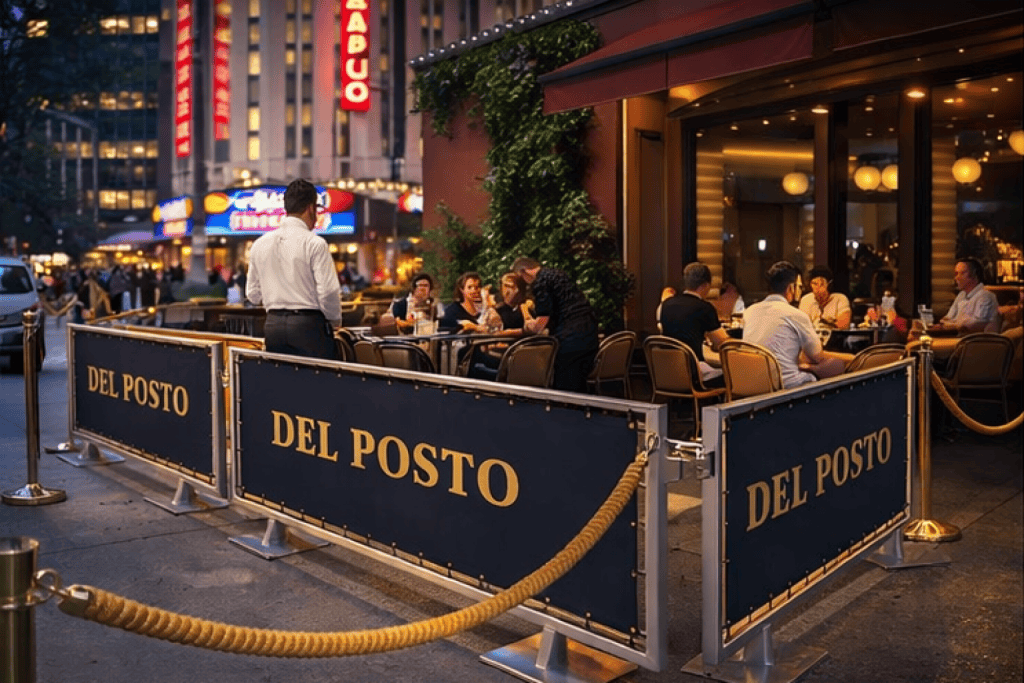
Patio Divider Panels: 6 Sidewalk Dining Barrier Options That Actually Work
We have been a 75+ year family-owned business long enough to know this: patio divider panels are not just a style choice. In NYC, Long Island, NJ, Philadelphia, MD, and DC, the right panel has to give you privacy, define the dining area, and still satisfy real public-way rules.
TL;DR: Summary
- Patio divider panels work best when you choose them around three factors first: pedestrian clearance, traffic visibility, and the level of privacy you actually need.
- For sidewalk dining, common panel choices are aluminum rail, steel pipe and rail, frosted tempered glass, laminated glass, acrylic or polycarbonate infill, perforated or mesh metal, and planter-integrated modular systems.
- Official guidance from places like Fairfax County, Costa Mesa, and Boston points to the same core standards: keep entrances and emergency egress clear, avoid blocking sightlines, and use barriers that clearly define the dining area.
- If a site sits in the public right of way, modular or removable systems often make more sense than fixed systems, especially where surface penetration is restricted.
- In our work, most custom sidewalk café barricade systems are priced from $135 per linear foot, with material, graphics, gates, and field conditions changing the total.
- In NYC and nearby markets, design should be checked against NYC DOT, Dining Out NYC, NYC DOB, Philly Streets Department, Philly L&I, MD jurisdictions, DC DDOT, and DC DCRA before fabrication.
We design, fabricate, and install these systems every day, and we do the fabrication in-house here in America. That matters because small field conditions, curb grades, and approval comments often decide whether a divider panel is useful or a problem.
What do patio divider panels need to do in sidewalk dining areas?
Patio divider panels must define the dining area and keep access clear. In NYC and Philadelphia, privacy comes second to pedestrian flow, emergency egress, and sightlines.
That is not just our opinion. Official guidance in Fairfax County says outdoor dining areas cannot obstruct fire equipment, building entrances or exits, emergency egress, ADA accessibility, or pedestrian passage. Boston requires barriers that clearly identify the seating area and are cane detectable, with a leading edge less than 27 inches from the ground.
“Quality Sidewalk Barricades has been family-owned for 75+ years and fabricates every system in-house in America.”
Visibility matters too. Costa Mesa’s published rules are a good example of what many reviewers look for: barriers may be up to 5 feet high, the lower 3.5 feet may be solid, and the upper 1.5 feet often needs to stay open or transparent outside the traffic visibility triangle. A common mistake is assuming a fully opaque privacy wall is acceptable just because it fits the brand look.
How do you choose patio divider panels for privacy without creating permit problems?
You choose privacy panels by starting with the site, not the material. In Manhattan and Brooklyn, the safest path is to decide what must stay visible before you decide what can be screened.
Start with corners, curb cuts, crosswalk approaches, and entry doors. If the panel sits near the public right of way, ask a simple question: if a driver, cyclist, pedestrian, or inspector needs to see through this area, should the upper portion stay transparent? If yes, frosted tempered glass, laminated glass, or a mixed panel often makes more sense than solid aluminum.
Then check use. If you need wind control and table separation, partial privacy is usually enough. If you want to block direct views between dining zones, use solid lower sections and more open upper sections where the site demands it.
Last, think about daily operation. Gates, removable sections, host stand access, and furniture circulation matter more than many owners expect. A nice-looking divider that traps staff movement or pinches service aisles gets old fast.
When budgeting, keep the whole system in mind. Our custom sidewalk café barricade work typically starts from $135 per linear foot, then changes with panel material, branded graphics, gates, planter integration, and installation conditions in places like Queens, Long Island, NJ, Philadelphia, MD, and DC.
What are the 6 patio barrier panel options for outdoor dining?
The six most practical options are aluminum rail, steel pipe and rail, glass panel systems, polycarbonate infill, perforated metal, and planter-integrated modular dividers. Each solves a different mix of privacy, visibility, and handling.
Before choosing, match the panel type to the site. A curbside setup in NYC has different demands than a private patio in NJ or a sidewalk enclosure in Philadelphia.
-
Custom aluminum rail with infill panels from Quality Sidewalk Barricades: Commercial-grade aluminum with a powder coat finish, commonly designed up to 5 feet where rules allow. Best for restaurants that need a clean branded look, removable sections, and site-specific layouts fabricated in-house in America.
-
Steel pipe and rail systems: Structural steel framing, also commonly designed up to 5 feet where allowed. Best for harder-use sites, larger footprints, or restaurants that want a more traditional street barrier feel.
-
Frosted tempered glass with aluminum framing: Frosted tempered glass set in aluminum framing, often used up to 5 feet where permitted. Best when you want privacy and light transmission without a heavy visual block.
-
Clear laminated glass with aluminum framing: Laminated safety glass in an aluminum frame, typically used up to 5 feet where visibility must be preserved. Best near traffic visibility concerns or where a more open dining edge helps the space feel larger.
-
Acrylic or polycarbonate infill panels: Acrylic or multi-wall polycarbonate infill, including 5/8 inch polycarbonate examples used in the market for wind protection. Best when weight, impact resistance, and faster handling matter more than the look of glass.
-
Perforated metal, mesh, or planter-integrated modular dividers: Powder-coated aluminum or zinc-coated steel panel faces, or modular panels built into planters, commonly used up to 5 feet where approved. Best when you need airflow, a cane-detectable lower edge, and a system that can define the area without surface penetration.
The right answer depends on whether privacy, sightlines, or removability matters most. If the site is tight, a mixed system often works better than one material from end to end.
“Quality Sidewalk Barricades prices most custom sidewalk café barricades from $135 per linear foot.”
Which patio divider panel materials work best for wind, privacy, and visibility?
Frosted glass, laminated glass, and polycarbonate each solve a different problem. Aluminum and perforated metal are often the easiest long-term maintenance choice.
If you want the clearest comparison, think in terms of trade-offs. More privacy usually means less visibility. Less weight usually means more scratching or a different finished look.
- Frosted tempered glass: Good privacy with light transfer; useful where diners should feel separated without creating a dark edge.
- Laminated glass: Best visibility; useful near traffic visibility triangle concerns and open street-facing dining.
- Polycarbonate or acrylic: Lighter and impact resistant; useful for wind screening and modular panels, but surface scratching is a real concern.
- Powder-coated aluminum or perforated metal: Durable and easy to maintain; useful where airflow, branding, and lower service demands matter more than transparency.
A common misconception is that clear glass is always the safest choice for approvals. It is often helpful, but if reflections, framing, or planter placement still block sightlines, the material alone will not solve the issue.
How do you measure a patio divider panel system before design and fabrication?
Good divider panels start with field measurement. In Manhattan, Brooklyn, and DC, a half-inch mistake can show up fast at a curb, column, or doorway.
First, measure the full run, then the real obstructions. Door swings, cellar doors, utility covers, curb slopes, tree pits, drains, and façade offsets all matter. If the panel crosses changing grades, the base detail matters as much as the panel itself.
Next, identify the must-keep-clear zones. That includes entrances, exits, accessible routes, service paths, and any area that could affect traffic visibility. Boston’s cane-detectable rule is a good reminder that the lower portion of the barrier cannot be treated as an afterthought.
Then design to the actual site, not a catalog size. Because we handle in-house American fabrication, we can build around field dimensions instead of forcing a standard panel onto a non-standard sidewalk.
“Quality Sidewalk Barricades handles site surveys, design, engineering, permit guidance, fabrication, and installation.”
Pro tip: do not measure only wall to wall. Measure where the panel posts, feet, planters, or base plates will actually land.
How do modular and removable patio divider panels compare with fixed framed systems?
Modular and removable panels are usually the better fit for public-way dining. Fixed framed systems make more sense on private patios, decks, and long-term enclosures with stable site conditions.
If the divider sits on a sidewalk or in a curb lane, you may need a system that can be removed seasonally, adjusted for agency comments, or installed without penetrating the public way. Boston’s published guidance specifically says barriers may not penetrate the surface of the public way, which is one reason planter-integrated and weighted modular systems stay popular.
Fixed framed systems still have a place. On private property, they can feel more permanent and reduce movement in windy areas.
ProNatural Landscape’s guidance on paver patio installation underscores the point: stable, well-prepared patio bases accept permanent edging and anchored fixtures reliably, making fixed rail or glass framing a sensible long-term choice where conditions are controlled.
Still, if your layout changes often, fixed framing can cost you flexibility later.
The usual rule is simple. If you expect seasonal dining, agency revisions, or frequent reconfiguration, modular wins. If the site is stable and the enclosure is staying put, fixed systems can be worth it.
How do permitting and installation usually work in NYC, Philadelphia, MD, and DC?
Permitting usually starts with a site check and layout review. In NYC and DC, no fabricator should promise approval before the site, drawings, and agency comments are reviewed.
In NYC, patio divider panels for sidewalk dining may involve NYC DOT, Dining Out NYC, and sometimes NYC DOB depending on the condition and scope. In Philadelphia, the usual review path points toward the Philly Streets Department and Philly L&I. In DC, think DC DDOT and DC DCRA. In Maryland, the exact path changes by county and municipality, so the jurisdiction has to be identified early.
The cleanest process is usually this: survey the site, prepare the layout, check visibility and access, select the panel type, submit the required material, then fabricate after comments are addressed. We can help with the permit side, but we never treat it as automatic.
After approval or sign-off to proceed, installation is usually straightforward if the field survey was right. This is where in-house American fabrication helps, because odd return angles, grade shifts, and gate clearances can be corrected before the crew shows up.
What questions do buyers ask about patio divider panels?
Most buyers ask the same five things. They want to know what is allowed, what lasts, what costs the most, and how fast the system can be put in place.
Do patio divider panels have to be transparent?
No. Many sites allow solid lower sections, but visibility often matters at the upper portion or near corners. Costa Mesa’s public guidance is a useful benchmark: the lower 3.5 feet may be solid, while the upper 1.5 feet may need to stay open or transparent outside the traffic visibility triangle.
Can patio divider panels be attached to the sidewalk?
Sometimes no, and that matters. Boston’s published outdoor dining rules say barriers may not penetrate the surface of the public way, which is one reason removable and planter-based systems are common in restaurant work.
What height is usually used for outdoor dining divider panels?
Many reviewers focus on keeping barriers at or below 5 feet where that standard applies. Actual allowed height depends on the jurisdiction and exact site condition, so in NYC, Philadelphia, MD, and DC, the agency review still controls.
What do patio divider panels cost?
For budgeting, our custom sidewalk café barricade systems typically start from $135 per linear foot. Glass, polycarbonate, gates, logos, planter integration, and difficult field conditions can change the total.
Can you build for sites outside NYC and Philadelphia?
Yes. We crate and ship complete systems nationwide and internationally, and we also provide local install service across NYC, Long Island, NJ, Philadelphia, MD, and DC.
If you want a patio divider panel system that fits the site, the rules, and the way your staff actually works, call +1 (800) 561-6522 or visit the contact/shop page.