
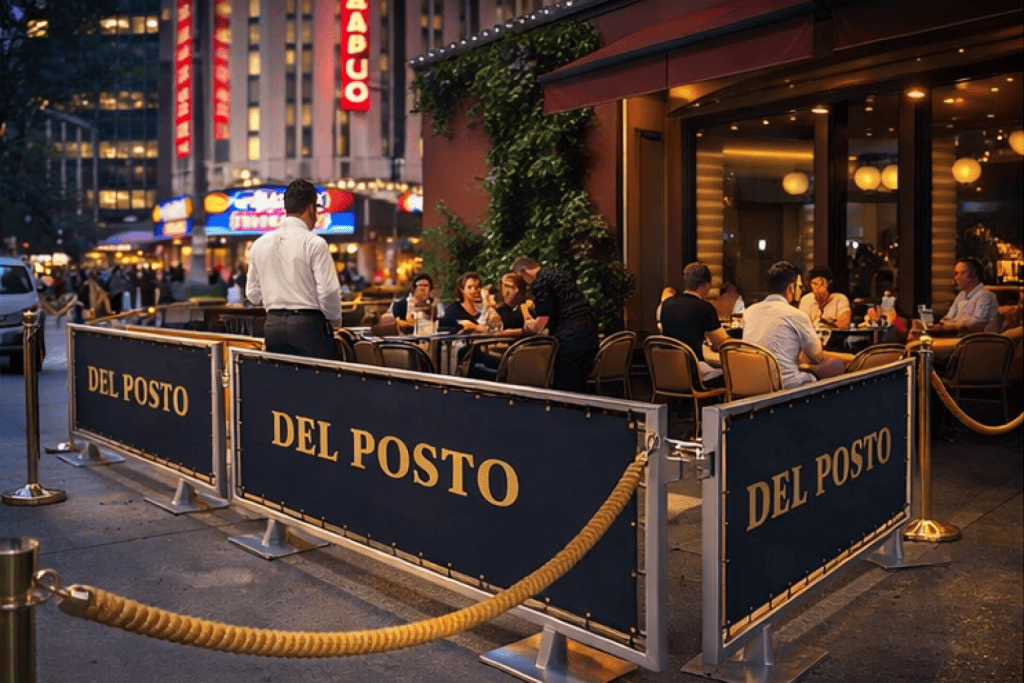
Outdoor dining barricades do not wear out all at once. They fade. They chip at the base. They start showing corrosion where water sits or where daily foot traffic rubs the finish thin. After 75+ years as a family-owned business, we have seen that pattern enough times to know that the coating system matters just as much as the frame.
At Quality Sidewalk Barricades, we design, fabricate, and install custom sidewalk café barricades across NYC, Manhattan, Brooklyn, Queens, Long Island, NJ, Philadelphia, MD, and DC. When you need a barrier that keeps its appearance through rain, sun, splash, and constant use, powder coating is often the right answer.
Powder Coated Barricades for Daily Outdoor Use
Powder coated barricades deal with rain, sun, salt, and sidewalk abrasion every day
A restaurant barricade lives in a harder setting than most people expect. It is outside all day. It gets hit by UV, wet sidewalks, curb splash, winter residue, hose washdowns, chair contact, delivery carts, and the occasional scrape from stacked equipment.
That is true in Manhattan curb lanes, on sidewalks in Brooklyn and Queens, along Long Island main streets, in NJ downtown dining zones, and in Philadelphia, MD, and DC service areas where weather shifts fast and maintenance crews move around them constantly.
The finish has to hold up to more than rain.
After enough seasons, the weak points show up in the same places. Bases sit close to water. Touch points take repeated abrasion. Fast-moving setups can nick corners and rails. If the coating system is not built for outdoor exposure, you see it quickly.
- Rain and standing water
- Road salt and traffic splash
- UV exposure
- Chair, stroller, and cart contact
- Nightly cleaning and wipe-downs
Powder coating protects metal barricades through corrosion resistance and weatherability
Powder coating works because it is designed as a protective finish, not just a color layer. On outdoor barricades, that matters. You are not buying paint for looks alone. You are buying a coating system meant to help the metal resist corrosion, weather exposure, and everyday wear.
Industry sources are consistent on this point. Powder-coating durability depends on a balance of corrosion resistance, weathering performance, abrasion resistance, flexibility, and coating chemistry. PCI Magazine also notes that the topcoat used for outdoor weathering, chemical resistance, and chip resistance is commonly a polyester-based coating cured with crosslinkers like TGIC, hydroxy alkyl amide, or blocked isocyanate.
That does not mean every powder coated barricade is equal. Prep, substrate, coating selection, cure, and assembly details all matter.
When we discuss quality and sourcing, we keep it plain. We use in-house American fabrication so we can control frame prep, fit, weld quality, and finish decisions before installation or shipment. That matters whether you are specifying commercial-grade aluminum with powder coat finish, steel pipe and rail, metal mesh and perforated panel, or glass panel with aluminum framing.
Powder coating is also widely tied to longer maintenance intervals than liquid coatings. The Powder Coating Institute says powder coatings keep their protective and visual qualities much longer than liquid coatings, especially outdoors, and often need fewer touch-ups, refinishing cycles, or full repainting. SAE literature has long pointed to superior corrosion resistance compared with many liquid counterparts as well.
ASTM B117 and ISO 9227 explain how powder coated barricades are evaluated
When you hear that a coating system has been tested for corrosion resistance, salt spray testing is usually part of the conversation. That is useful, but it needs to be explained the right way.
ASTM B117 is a controlled corrosive environment used to produce relative corrosion resistance information for coated metal specimens. In plain terms, it lets manufacturers and specifiers compare how coatings perform under the same harsh test conditions. ISO 9227 covers neutral salt spray, acetic acid salt spray, and copper-accelerated acetic acid salt spray methods for metallic materials with or without corrosion protection.
The important phrase is relative corrosion resistance. Salt spray testing is a comparison tool. It is not a perfect clock for real sidewalk life in SoHo, Center City Philadelphia, or a waterfront block in Brooklyn. As Havemekka explains in its guidance on outdoor materials for coastal climates, salt-laden moisture and repeated damp–dry cycles can speed up wear on exterior fittings beyond what lab hours alone suggest.
ISO also states that these methods are suitable for checking whether the quality of a metallic material with corrosion protection is maintained. That makes them useful when you want a barricade system built for repeatable outdoor performance, not guesswork.
- ASTM B117: controlled salt fog testing used to compare relative corrosion resistance
- ISO 9227: neutral salt spray and other related methods for assessing corrosion resistance
- What the tests do well: compare coating systems under the same lab conditions
- What the tests do not do: predict exact service life on your sidewalk
Daily maintenance is usually lighter with powder coated barricades
The day-to-day value of powder coating shows up after installation. You wipe it down. You wash around it. Staff brush past it with chairs and bus tubs. Weeks go by, then months, then seasons. A good powder coated finish tends to keep looking stable through that cycle with fewer touch-ups than many liquid-painted alternatives.
That does not mean it is indestructible. If a barricade is gouged hard enough, or if standing water is ignored around any metal system, maintenance is still part of the job. Still, powder coatings are consistently associated with stronger outdoor protection and less frequent refinishing.
Here is a practical way to think about it:
| Daily condition | What powder coating helps resist | What you still need to watch |
|---|---|---|
| Rain and curb splash | Corrosion pressure on exposed metal surfaces | Chips or deep scratches left unrepaired |
| Sun exposure | Color and finish retention through weatherability | Long-term fading if the wrong coating is specified |
| Moving chairs and contact wear | Abrasion and chip resistance | Repeated impact at corners and gates |
| Cleaning and washdowns | Better surface durability than many liquid coatings | Harsh treatment that cuts through the finish |
| Seasonal outdoor use | Longer intervals between refinishing in many cases | Hardware wear, drainage, and site abuse |
A barricade that needs less touch-up is not just easier on maintenance. It also looks more consistent for guests.
In-house American fabrication matters when you specify powder coated barricades
We have been a 75+ year family-owned business long enough to know that weather performance starts before the coating is ever applied. It starts with the right frame design, the right material for the location, and clean production control from the shop floor through installation.
That is why in-house American fabrication matters. If a restaurant in Manhattan needs a modular/removable system for Dining Out NYC review, or a Philadelphia property needs a layout prepared for Philly Streets Department and Philly L&I review, we can build to exact field conditions instead of forcing a stock panel into a site that was never measured correctly.
We have installed in Manhattan, Brooklyn, Queens, Long Island, NJ, Philadelphia, MD, and DC. We have also handled approvals and submittal support tied to NYC DOT, Dining Out NYC, NYC DOB, Philly Streets Department, Philly L&I, MD jurisdictions, DC DDOT, and DC DCRA. No one can promise approval, but real site-specific preparation helps avoid preventable problems.
Material choice still depends on the use case. Commercial-grade aluminum with powder coat finish is often the first place we look for outdoor dining because it gives strong corrosion resistance and manageable weight. Steel pipe and rail can make sense when added mass is useful. Glass panel with aluminum framing can create a cleaner visual edge. Acrylic/polycarbonate infill can reduce openness while keeping a lighter panel. Metal mesh and perforated panel can take daily contact well. Planter-integrated and modular/removable systems are often chosen where layout flexibility matters.
We also crate and ship complete systems nationwide and internationally, but most of our day-to-day field work stays grounded in the Northeast and Mid-Atlantic where curb conditions, permitting, and daily weather are real operating issues, not sales talking points.
Powder coated barricade cost starts with linear footage and site details
If you are budgeting outdoor dining barriers, we keep pricing direct. Our standard reference point is $135 per linear foot. That gives you a clear baseline instead of vague allowance numbers that drift later.
The final number can move based on frame material, infill choice, removable hardware, branded graphics, gates, planter integration, engineering needs, and installation conditions. A straight aluminum rail run is different from a glass panel system with custom access points.
What matters is getting the scope right early. If your project needs submittal support for NYC DOT and Dining Out NYC, review coordination for NYC DOB, or documentation for Philly Streets Department, Philly L&I, MD jurisdictions, DC DDOT, or DC DCRA, that should be part of the conversation before fabrication starts.
- Base pricing: $135 per linear foot
- Common cost drivers: glass panels, acrylic/polycarbonate infill, custom branding, gates, removable sections
- Why site review matters: exact measurements reduce fit issues and rework
- What we avoid: hidden quote games and vague placeholders
FAQ About Powder Coated Barricades and Weather
Are powder coated barricades better for rain and outdoor exposure?
In most outdoor dining settings, yes. Powder coating is widely associated with better corrosion resistance and weatherability than many liquid-painted alternatives, which is why it is commonly chosen for exterior metal systems.
Does salt spray testing prove how many years a barricade will last?
No. ASTM B117 and ISO 9227 salt spray methods are used to compare relative corrosion resistance and check coating quality under controlled conditions. They are useful tests, but they do not give an exact real-world lifespan for one sidewalk location.
What barricade materials work well with powder coating?
Commercial-grade aluminum with powder coat finish is a common choice for sidewalk café barricades. Steel pipe and rail, metal mesh and perforated panel, and aluminum-framed systems also pair well with powder coating when the coating system and prep are selected for outdoor use.
Do powder coated barricades still need maintenance?
Yes. They usually need less frequent touch-up than many liquid-coated systems, but they still need cleaning, periodic inspection, and attention to chips, hardware wear, and drainage conditions.
Can powder coated barricades be used for permitted outdoor dining in NYC or Philadelphia?
They can, if the system is designed to the site and prepared for the right review path. We regularly build for projects tied to NYC DOT, Dining Out NYC, NYC DOB, Philly Streets Department, and Philly L&I, along with MD jurisdictions and DC DDOT and DC DCRA requirements.
If you need powder coated barricades built for daily outdoor use, call +1 (800) 561-6522 or visit the contact/shop page.